
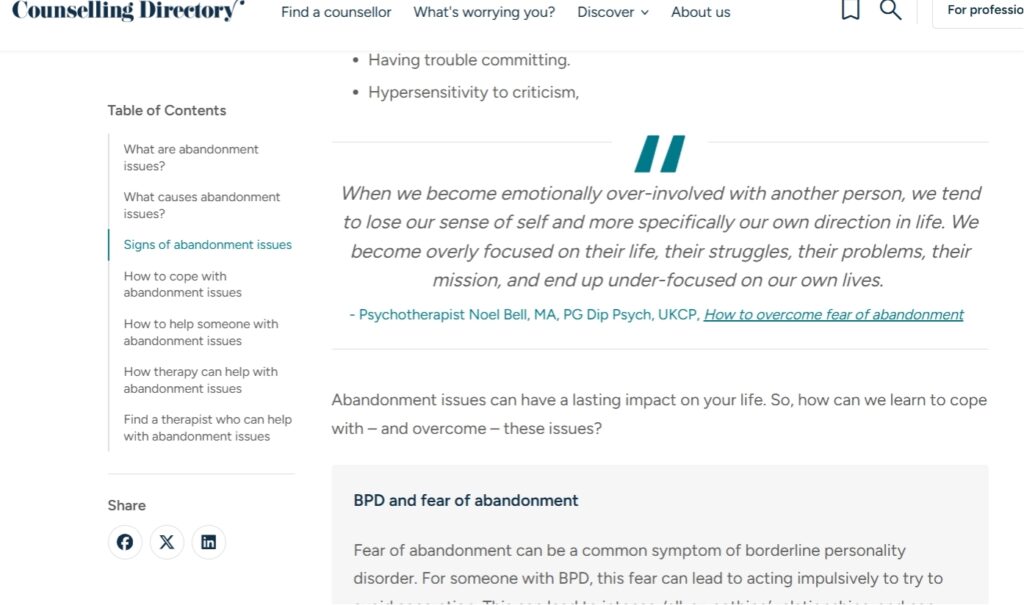
This post covers abandonment issues and how to seek help. I recently reviewed the guidance page on Counselling Directory for the topic of abandonment issues. The Counselling Directory is part of the Happiful Family and is an online platform in the UK that connects people seeking mental and emotional health support with qualified counsellors and psychotherapists. Founded in 2005 it has grown to be a leading provider of such services in the country. In the “What’s worrying you” pages there is guidance information on a variety of topics that get reviewed every now and then. These guidance notes can help you to navigate support and seek help. Have a look, if the topic interests you.
Abandonment issues are often closely referenced with early life events that might be termed developmental ruptures. Ruptures might be absent or inconsistent care-givers, abuse, domestic violence, alcoholism, or anything that a child perceived as unsafe. John Bowlby’s Attachment Theory would hold that such experiences can threaten the formation of, or the sabotage of what is termed a secure base. A secure base is a psychological safe foundation provided by caregivers so that a child can confidently explore the outside world and return for comfort during stress. These early attachment wounds are often associated with the formation of fixations that can lead to insecure relational styles in adulthood.
The trouble with discussing where fears of abandonment originate from is that there tends to be an over emphasis on the nurture side of the nature/nurture debate within the broad therapy field. It is almost as if there is a deterministic relationship between what happened in childhood and subsequent adult relational styles. The nurture argument (meaning all environmental learnings) essentially emphasizes that attachments are made, not born, through lived experiences. Nature (biological and innate), on the other hand, places more emphasis on attachment being hardwired for survival. Twin studies, for instance, indicate that roughly 40% of the variation in adult attachment styles can be attributed to genetic factors.
Fear of abandonment might, therefore, be a product of both nature and nurture, occurring through a complex interaction between biological predispositions and early life experiences. There might be genetic inheritability, innate survival instinct and biological sensitivity but life experiences can heavily influence whether a fear of abandonment actually develops. Such life experiences could be ruptures, as previously mentioned, such as caregiver inconsistency, traumatic loss or childhood neglect.
As the guidance notes state, different kinds of therapy can be helpful for different people, and for different kinds of fears of abandonment. It is possible to achieve an ‘earned secure attachment’ by healing past wounds and experiencing healthy reparative relationships.
See also: How to overcome fear of abandonment
Noel Bell is a UKCP accredited psychotherapist and can be contacted on 07852407140.