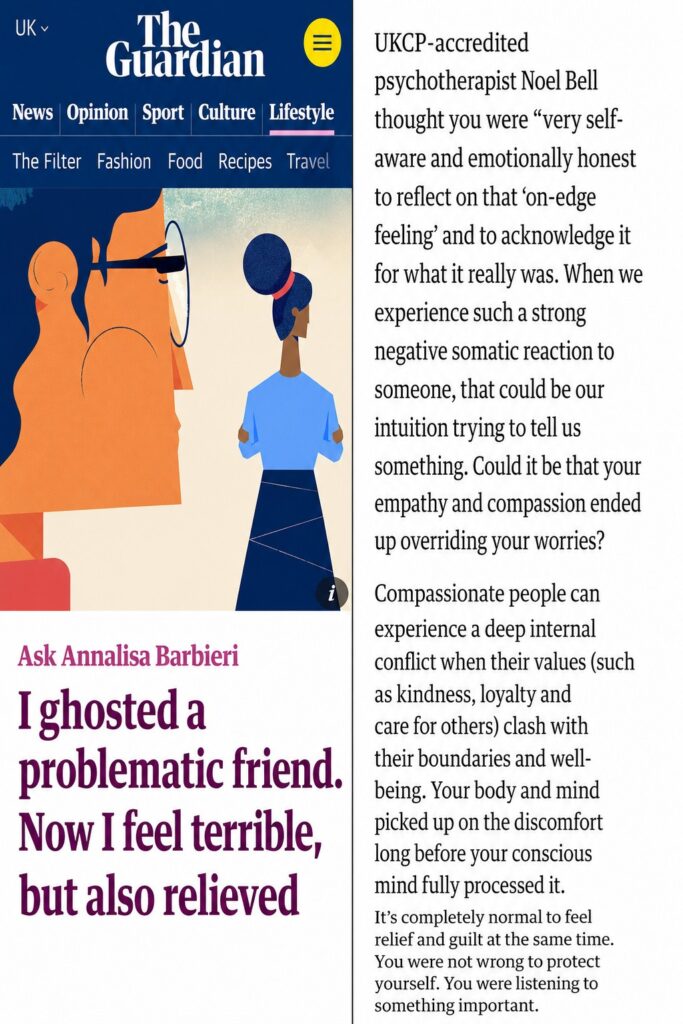
The latest Ask Annalisa article in the Guardian concerns a reader’s personal problem about guilt after ghosting a friend. This week it was about someone who had ghosted a friend of a few years following an outburst against them as they didn’t know what else to do.
I was asked by journalist Annalisa Barbieri for comments, especially on how to process the guilty feelings associated with the decision to ghost a friend in these circumstances.
This reader had known a friend for a few years and had always felt a bit on edge around them. They had tried to push past that feeling and give them an opportunity, particulary as their friend had experienced trauma in their childhood. They had spotted a pattern quite early on where they seemed incapable of maintaining friendships for any length of time. Then they slowly started to notice that their friend often snapped at people when they were no longer able to be of service to them. They were then subject to an outburst themselves. Even though they feel that they could justify the subsequent ghosting they still feel guilty and don’t know how to move on from that feeling as they have never had to do it before with any other friendship.
The first point I made was that it takes a lot of self-awareness and honesty to reflect on that “on-edge” feeling and to acknowledge it for what it really was. If we experience a strong negative reaction to somebody, such as a tightening in our chest or a sense of exhaustion after bring with them, that could be our intuition talking. Perhaps their intuition was seeking to protect them from this person from the very start, but their empathy and compassion ended up overiding the flags. Compassionate people often confuse healthy accommodation for others with tolerating toxic behavior.
The friend’s past trauma (though not specified) possibly related to attachment wounds with caregivers in their early life when they suffered some form of rejection, neglect or abandonment.
Having childhood trauma or mental health issues perhaps explains why a person might have intense emotional triggers. But it does not give them a free pass to mistreat others. When someone says an outburst “isn’t personal,” they in a way are trying to erase the impact of their actions. Maybe you are angry with them that they weaponised their mental health as a way to deflect accountability and make you feel like the bad guy for being upset.
When a friendship requires you to suppress your own stress, life priorities, and well-being just to keep the other person stable, it becomes an unsustainable caretaking role. The friendship has become one way.
The reader’s relief could mean that they did the right thing. It is entirely understandable to feel guilt after moving away from a volatile friendship and it is very common that this decision might leave a form of emotional hangover. They didn’t just vanish into thin air without reason. They accepted their apology to keep the peace, and then they tried a standard, gentle boundary: replying less frequently. The ghosting ocurred because the gentle approach failed, leaving them with few other options.
In this case, anger is a healthy sign that one’s self-esteem is working. It is the part of us that recognizes that we were treated unfairly and says, “I deserved better than that.” What is not so healthy is resentment, the re-feeling of anger, which often lingers because a boundary was severely crossed, and you never got the apology, validation, or closure you deserved. Since you cannot get that closure from them, you have to build it for yourself.
The next time you meet someone and feel that subtle, persistent “on-edge” feeling, you no longer have to rationalise it away. You can say to yourself: “I tried pushing past this feeling in the past, and it ended up draining me. I am going to trust my gut this time and keep my distance.” Some people are dragging around a lot of emotional baggage, perhaps we all are, but are we all willing to work on our own material to bring about change in our lives? Perhaps this person referred to in the letter is not willing to do so.
See also when ghosting happens to you
Noel Bell is UKCP accredited psychotherapist and can be contacted on 07852407140